
Essay
Formalization-First Development: What Should Humans Review?
A friend who works in orbit determination and guidance, navigation, and control (OD/GNC) asked Claude whether formal methods would be useful for everyday software engineering in his field. The answer was skeptical—or at least reserved.
That was fair. OD/GNC software sits on top of physical models, noisy sensors, numerical solvers, estimation algorithms, and operational assumptions. Proving a tidy algebraic property about one small function does not prove that a spacecraft will go where we want it to go.
So I set myself a more concrete challenge: Can an AI agent take an algorithm from an OD/GNC paper, implement it, and prove a meaningful correctness property about the complete software function in one afternoon?
I more or less randomly chose Bury, Zajdel, and Sośnica’s paper, “Design of the broadcast ephemerides for the Lunar Communication and Navigation Services system”, and formalized its Chebyshev position-reconstruction algorithm. The particular paper was not the point; it provided a realistic test case.
I used Lean, a programming language and proof assistant, to formalize the paper’s algorithm and verify its floating-point implementation. For every supported decoded message and query time, the Lean receiver is proved to succeed, return finite coordinates, and stay within 10 micrometers per axis of the ideal real-number algorithm. I also produced ordinary Python and Rust implementations and tested them against the Lean versions. The complete Chebyshev ephemeris project is available on GitHub.
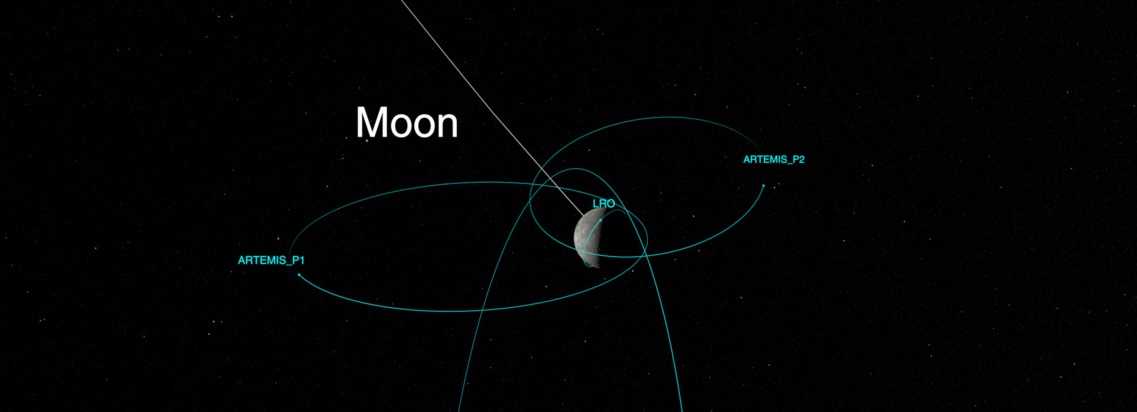
NASA’s heliophysics fleet in orbit around the Moon. Source: NASA Scientific Visualization Studio.
From spec-driven to formalization-first
GitHub’s Spec Kit describes spec-driven development as making the specification the primary artifact and letting the implementation follow from it. That direction makes particular sense for AI: settle what we mean, then ask the agent to build it.
Formalization-first strengthens that workflow by making the specification formal and requiring a proof that the implementation meets it. The pipeline is human intent → Lean specification, implementation, and proof → production target languages.
For the algorithm itself, Lean is the development language: it is where I specify, implement, prove, and perform the main semantic review. Python, Rust, JavaScript, and other languages are becoming more like compile targets—almost like instruction set architectures (ISAs) for their runtime environments. Prose specifications still provide goals and context, and tests remain useful, but the formal specification and proof become part of the deliverable.
Human interaction concentrates on interpreting intent and reviewing the specification and theorem. Once those are settled, AI can drive the proof and production-language ports; the Lean implementation can be human-shaped or AI-driven depending on how much design direction it needs.

The paper’s math remains recognizable in Lean
An ephemeris message carries coefficients that let a receiver calculate a satellite’s position at a requested time. The algorithm normalizes the time, builds 11 Chebyshev basis values, and sums one polynomial for each of the X, Y, and Z coordinates.
Here is the core mathematics. Let t₀ and t₁ bound the message’s validity
interval, a be its transmitted coefficients, and k select an axis:
Here are the corresponding real-number source equations and independent polynomial sum in Lean, shown together for comparison:
def normalizeEpoch (jdMin jdMax t : ℝ) : ℝ :=
  2 * ((t - jdMin) / (jdMax - jdMin)) - 1

def chebyshevT (x : ℝ) : Nat → ℝ
  | 0 => 1
  | 1 => x
  | n + 2 => 2 * x * chebyshevT x (n + 1) - chebyshevT x n

noncomputable def polynomialBasis (i : Nat) (x : ℝ) : ℝ :=
  (Polynomial.Chebyshev.T ℝ (i : ℤ)).eval x

noncomputable def polynomialCoordinate (n : Nat) (a : List ℝ) (x : ℝ) : ℝ :=
  ∑ i ∈ Finset.range (n + 1), a.getD i 0 * polynomialBasis i x
The normalization, base cases, and recurrence have clear counterparts in the
Lean source equations;
the coordinate sum appears in polynomialCoordinate above. A domain expert can
compare the paper and specification one item at a time, before considering
floating-point code or control flow.
Prove the whole receiver, not a toy property
After reviewing what the algorithm means, the next question is what the actual floating-point function promises. The property to prove is:
\[\begin{aligned} \forall m,t,\quad &\operatorname{ValidMessage}(m) \land \operatorname{InWindow}(m,t) \\ &\Longrightarrow \exists r,\quad \operatorname{evaluate}_{64}(m,t)=\operatorname{ok}(r) \\ &\qquad\land\ \operatorname{finite}(r) \land \lVert r-\operatorname{reconstruct}_{\mathbb R}(m,t)\rVert_\infty \le 10^{-5}\ \mathrm{m}. \end{aligned}\]Here, ValidMessage means that the message has the supported field ranges and
coefficient layout, while InWindow means that the query falls within its
validity period.
In Lean, UniformAccuracy states the guarantee; the theorem uniformAccuracy
proves it for a 10-micrometer limit:
def UniformAccuracy (tolerance : ℝ) : Prop :=
  0 ≤ tolerance
  ∧ ∀ m time,
      ValidMessage m
      → InWindow m time
      → ∃ result,
          Implementation.PositionReconstruction.evaluate m time = .ok result
          ∧ Binary64Within (result.map Float.toModel)
              (Definitions.PositionReconstruction.reconstruct m time) tolerance

theorem uniformAccuracy :
  Implementation.Correctness.Float.UniformAccuracy (1 / 100000)
evaluate
is the floating-point implementation of the receiver, and
reconstruct
is the real-number specification.
The UniformAccuracy statement
uses Binary64Within to require finite coordinates and a per-axis error bound;
the uniformAccuracy proof
establishes it for the native Lean evaluator. Together, they cover accepted
input, successful return, finite output, and a uniform accuracy bound against
the real-number specification. This is a guarantee about the complete function,
not just one example or an intermediate algebraic property.
It verifies position reconstruction from a decoded message, not the entire orbit-determination pipeline. That is the point: prove one whole software function and state exactly what the proof covers.
Production languages become compile targets
The core Python loop is unsurprising:
argument = normalized_epoch(message, time)
basis = [1.0, argument]

for i in range(2, 11):
    basis.append(2.0 * argument * basis[i - 1] - basis[i - 2])

position = []
for axis in message.coefficients:
    total = 0.0
    for i in range(11):
        total += coefficient(axis[i]) * basis[i]
    position.append(total)
Python and Rust were ported by AI, not emitted by a verified compiler. I still review their integration, operation order, error handling, types, and language-specific hazards. The mathematical correctness argument lives in Lean; fuzzing provides evidence that the ports behave like the Lean implementation.
Differential fuzzing compared 30,464 requests across all four evaluators: 20,177 produced positions, and the rest exercised rejection behavior. The native implementations agreed bit for bit on successful queries. This is strong empirical evidence that the ports preserve the verified Lean behavior, not a machine-checked equivalence proof across languages.
A plausible mistake, caught by the proof
The paper’s formula subtracts two times. An implementer might reasonably convert both absolute microsecond timestamps to floating point and then subtract:
# Plausible, but wrong for large absolute timestamps.
elapsed = float(query_us) - float(start_us)

# Preserve the exact small difference before conversion.
elapsed = float(query_us - start_us)
These expressions are equal over the real numbers. They are not equivalent in
binary64. At about 2.126e17 microseconds, adjacent representable values are 32
microseconds apart, so a one-microsecond query offset can disappear.
For one constructed valid message, the plausible mistake produces about 0.56 millimeters of position error: 55.6 times the theorem’s 10-micrometer limit. It demonstrates the kind of ordinary implementation mistake that the whole-function theorem rules out.
What changes for the reviewer
Formalization-first development does not remove human review. It lightens the burden by separating it into smaller questions:
| Artifact | Human review | Evidence in the package |
|---|---|---|
| Formal specification | Does this faithfully capture the intent? | Lean makes every definition precise and type-checkable. |
| Whole-function theorem | Is this the guarantee we actually need, over the right inputs? | Lean checks that the proved implementation satisfies it for every supported input. |
| Lean source and production targets | Is the code maintainable and suitable for production? | Proof covers Lean; differential tests compare the ports against it. |
The reviewer still brings domain expertise and software judgment, but no longer has to reconstruct the algorithm’s correctness from implementation code alone. Once the formal specification and promised error bound are accepted, Lean handles the exhaustive floating-point reasoning for the Lean implementation. Code review can focus on maintainability, integration, and language-specific risks. Differential fuzz testing provides additional evidence that the production ports preserve the proved behavior.
For a mathematical function with a precise definition, asking a human to establish correctness by mentally executing generated target-language code is a poor use of scarce human attention. Code review remains essential for integration and language-specific risks—but reviewing it without formal assurance of correctness is unnecessarily expensive.
Formalization-first development deliberately gives the AI more work so the human can review smaller, higher-leverage artifacts: intent, formal specification, and theorem statement.
What it cost
The experiment took about a day of elapsed time with an AI agent. That included my search for a suitable example, learning an unfamiliar paper and codebase, and refactoring the project. I did other things while the agent worked; this was not a full day of focused human engineering.
With the example chosen and the goal clear, I think the agent could produce the Lean, Python, and Rust implementation-and-proof package in a few hours. That is an estimate for the AI work, with some human steering, not for human review of the specification or code. Reusable AI skills could reduce the steering further. Compared with asking for code alone, this gives the agent a few more hours of work, but gives human reviewers a much better starting package.
Code, or code with evidence?
For this project, we did not just prove a recurrence lemma and declare victory. We proved the complete accepted floating-point receiver. Formalization-first development produced:
- a recognizable real-number specification tied to the paper’s algorithm;
- a Lean floating-point implementation with a whole-function guarantee: success, finite output, and at most 10 micrometers of per-axis arithmetic error for every supported message and query;
- ordinary Python and Rust implementations, differentially tested against the proved Lean executions.
The formal specification makes the intended algorithm easier to review, the theorem turns “correct” into a concrete promise, and the proof checks that promise over the entire supported input space. Together, they form a durable assurance package that can be rechecked whenever the implementation changes.
That is my broader thesis: formal verification will be a key to software productivity with AI. Formalization-first converts a few more hours of agent work into a much better human review package: We inspect the intent, specification, and guarantee, then let Lean check that the implementation meets them. Which deliverable would you rather review: code alone, or code with a precise formal specification and a machine-checked whole-function proof?
Code and proofs are now both cheap. Verified correctness is the necessary artifact.